
GREEN STAR RATING
4 Star Green Star
– Design & As Built v1.2
LOCATION
Washington, D.C.
COMPLETION
2023
TYPE
Government
OWNER
Department of Foreign Affairs and Trade
Architect:
Bates Smart
ESD consultant:
Aurecon, Arup
Acoustic consultant:
Aurecon
Building services engineer:
Aurecon, Interface
Quantity surveyor:
RLB
Structural / civil engineer:
Aurecon
Located in Washington D.C., the Embassy of Australia, is a symbol of best practice sustainable design, achieving not only a 4 Star Green Star rating, becoming the first embassy overseas to do so, but also the 2024 Jorn Utzon Award for International Architecture.
From its environmentally sensitive architecture to its warm interior aesthetics, the embassy is built in the spirit of Australia. The design promotes an enduring vision of a contemporary and innovative Australia, with materiality and light playing key roles in expressing the unique relationship with the Australian landscape. It embodies the welcoming Australian spirit with a sense of openness and warmth. The embassy’s environmentally sensitive design exhibits a striking tectonic quality where large shadow line joints define a series of aggregated forms, combining to create a dialogue between positive and negative space.
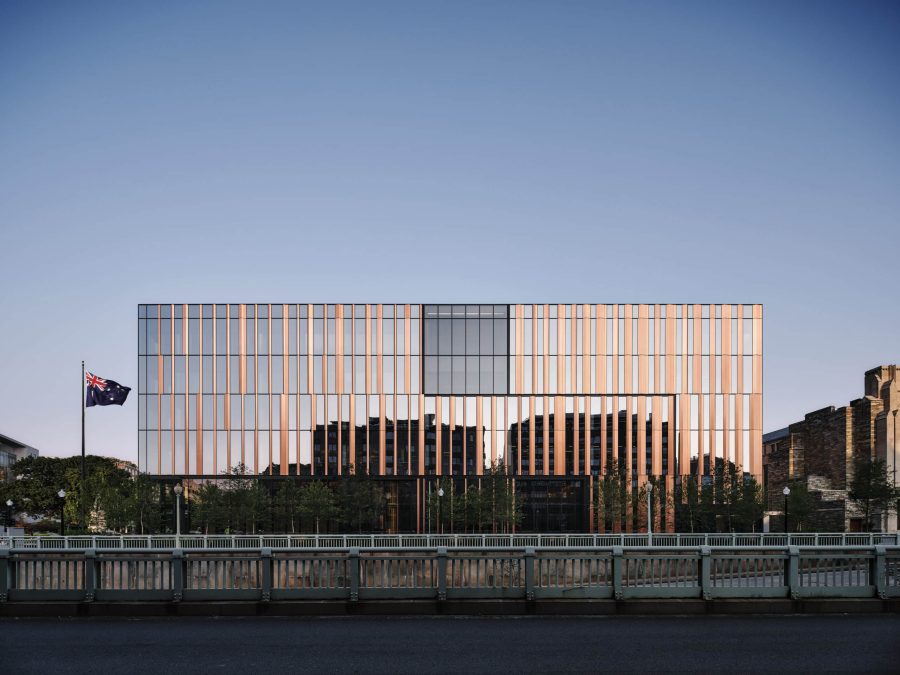
From the outside, the appearance of the building changes throughout the day depending on the perspective of the viewer and the seasonal transition of the sun. The interplay of angled copper cladding and extensive glazing combine to create a dynamic and engaging expression of Australia that is also respectful of the Washington, D.C. context.
Led by Melbourne-based architects, Bates Smart, the design references the distinctive Australian landscape: boundless, rich, earthy tones, endless natural light, and expansive internal scale.


At the heart of the building, a large atrium serves as an orientating space displaying a powerful connection between the ground and the sky. This central atrium gives rise to an axial arrangement of representational spaces where every visitor is granted an equally immersive experience.
The main representational spaces are defined by strong materiality with Australian timber panels organised around a series of textured horizontal bands that transition from rough to smooth. This mirrors the protective qualities of the bark during the eucalypt forest’s cycle of growth, burn and regrowth. Intricate metallic filigree screens mediate the interplay of light and shadow in social breakout and office spaces.
“The new design embodies the spirit of Australia through direct references to its distinctive landscape, with bright and clear natural light and open skies, warm materiality, and vast scale — creating a symbol of Australia that is both welcoming and enduring.
“The interior expresses the unique qualities of the Australian natural environment; the bold textures of our bushland and the soft filtered light which falls upon it,” said Steve Jones, Studio Director at Bates Smart.
Pragmatic, efficient and healthy – the Australian way
According to the project’s sustainability consultant, Aurecon, the project’s key sustainability objectives included energy efficiency, water conservation, wildlife habitat support, and aiding occupant health and well-being. This meant that it had to be all-electric.
The building has a large rooftop photovoltaic array of 96.8-kilowatts and offers 20 electric vehicle charging stations for staff members. The combined glass and copped clad façade is thermally efficient, and its energy saving performance is supplemented by the photovoltaic system, equating to approximately 7.7% of annual electricity demand. This system extends to the green roof which helps cool the exteriors of the building, while providing a beautiful outdoor location to take in the sights.
It’s HVAC system combines several highly efficient technologies, including:
- heat recovery VRF (variable refrigerant flow) system
- water-to-water heat pump equipment
- radiant floor slabs
- displacement ventilation systems
- heat recovery DOAS (dedicated outdoor air system)

Inner city ecosystem
A third of the site is home to a range of plant life, including 10,000 square feet of green space on the building’s roof. This considered space has become a place of respite for birds and is even home to an apiary of around 240,000 bees. The Australian Embassy provides a diverse ecosystem for insects and small animals while a tank retains the first 1.2 inches of rainfall on the site with 75% of its stormwater saved for reuse.
From the ground up
This project also championed the previous building that stood in its location, reusing the existing basement perimeter structure in the design of the Green Star rated embassy. This addressed the site’s outer edge constraints by adjacent roads and buildings, but importantly, it addressed waste by reducing the volume of new materials used on the project. The new build, while occupying the same footprint of its predecessor, is far more open and reflective of the Australian culture we know and love.
“The progression from the 1967 International Style building to the architecture of the new Embassy aligns with the emergence of Australia’s are and culture, and the celebration of what is uniquely Australian,” explained Jones.


After her visit to the embassy, GBCA CEO Davina Rooney recollected in awe of the symbolism of this achievement.
“The Green Star certification of the embassy is a testament to Australia’s leadership in sustainable design and construction, and the location in Washington—an iconic and historically influential city—only amplifies this message. What truly sets this project apart is the seamless integration of cultural and environmental elements.
The Indigenous designs woven into the rugs and cushions, the internal wall finishes that evoke the natural form and shade of gum trees and the copper façade that references the changing colouration of the Australian desert, speak to a deep connection with Australia’s natural heritage. This blend of design excellence and sustainability, all within a secure and thoughtful environment, is nothing short of extraordinary. We congratulate the Australian Department of Foreign Affairs and Trade, Bates Smart and Aurecon for their visionary approach.”
Project awards
The project was the first to be dual Green Star and LEED rated, with the project achieving LEED Gold alongside the 4 Star Green Star rating. The project has been recognised internationally with the following awards:
- AIA Architecture Awards, The Jørn Utzon Award for International Architecture
- AIA (International) Architecture Awards, The Louise Cox Award for Public Architecture, Winner
- AIA (International) Architecture Awards, Commercial Architecture Award, Winner
- AIA (International) Architecture Awards, Interior Architecture Award, Winner
- International Interior Design Association (IIDA) Awards, Best of Competition, Winner
- International Interior Design Association (IIDA) Awards, Institutional Category, Winner
- Inside World Festival Awards (WAF), Public Buildings, Winner
- World Interior News (WIN) Awards, Public Accessible Interiors – Civic, Winner
- Interior Design Excellence Awards (IDEA), Overall Project of the Year, Winner
- Interior Design Excellence Awards (IDEA), Public Space, Winner
- Australian Interior Design Awards (AIDA), Best International Design Award
- Australian Interior Design Awards (AIDA), Public Design Award, Commendation
- Design Institute of Australia (DIA), Place, Award of Merit
- Australian Timber Design Awards, Overall Winner
- Australian Timber Design Awards, International Project, Winner
- Australian Timber Design Awards, Fitout – Commercial and Public, Winner
- LIT Lighting Design Awards, Interior Architecture Illumination, Winner
Submitted by KCCT:
- ENR MidAtlantic, Best Project, Government / Public Building, Winner
- North American Copper in Architecture Awards, Public, Winner
- AIA|DC Chapter Design Award
- Washington Building Congress Craftsman Award, Architectural Millwork
- Washington Building Congress Craftsman Award, Exterior Glass