

Green Star rating
5 Star Green Star – Buildings v1
Location
Broadmeadows, Victoria, Wurundjeri Woi Wurrung Country
Certification
2026
Type
Education
5 Star Green Star – Buildings v1
Kangan Institute’s Health and Community Centre of Excellence combines state-of-the-art spaces and technology-enabled learning in a 5 Star Green Star training facility.
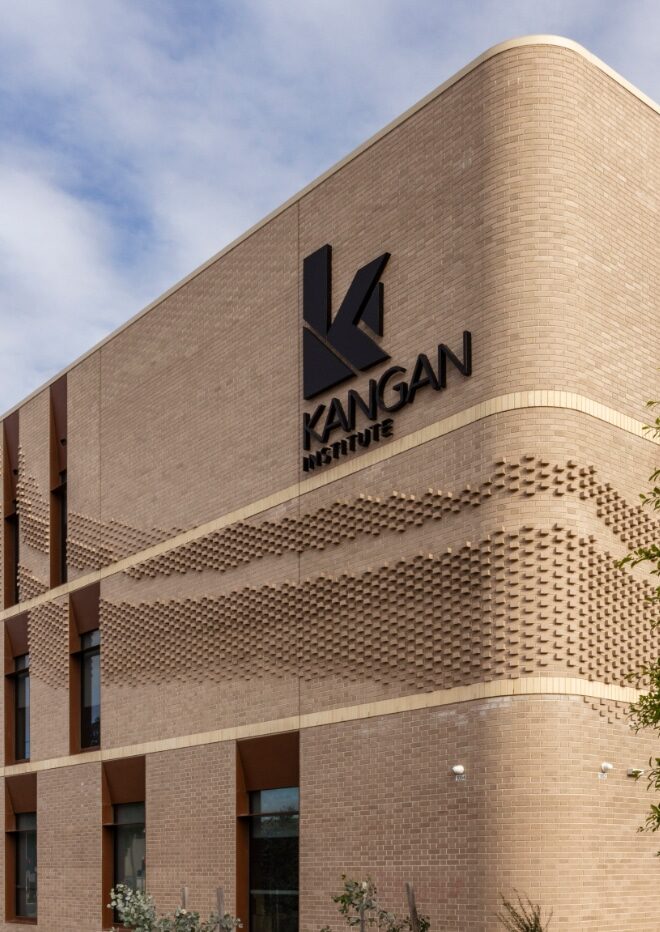
The Health and Community Centre of Excellence at Kangan Institute’s Broadmeadows Campus is a purpose-built education facility supporting Victoria’s health and community services workforce. Located in Melbourne’s northern growth corridor, on the traditional lands of the Wurundjeri Woi Wurrung people of the Kulin Nation project delivers integrated health and community training infrastructure to support workforce development and expanded access to education.
Funded by the Victorian Government, the decision to pursue a 5 Star Green Star Buildings certification reflected Kangan Institute’s commitment to sustainability and reducing its carbon footprint.
Impact through design
Sustainable and healthy buildings are central to Kangan Institute’s capital works strategy, recognising the link between the built environment, wellbeing, and learning outcomes.
Some of the key sustainability and innovation outcomes for the Health and Community Centre of Excellence at Broadmeadows include:
- Around a 35% reduction in upfront carbon primarily through the selection of green concrete mixes
- Approximately 46% reduction in building energy use compared to a reference building through a combination of passive design measures, efficient building services and 92.4kW of solar PV renewable energy integration.
- The building is all-electric and powered by 100% renewable energy, and approximately 22% of building energy demand supplied through on-site renewable energy.
- Approximately 50% annual stormwater reuse, reducing reliance on potable water with greater than 40% annual stormwater re-used on site
- Exceptional building airtightness performance (1.44 m³/h/m² @ 50Pa), significantly exceeding Green Star benchmarks and improving energy efficiency and occupant comfort.
- Daylight optimisation, with approximately 51% of occupied spaces achieving high levels of natural daylight, supporting student and staff wellbeing.
- A 93% reduction in construction waste sent to landfill, achieved through recycling and reuse of construction materials.
- Over 6% (by cost) of contract works meet Green Star social procurement criteria.
The project also reflects Kangan Institute broader approach to Indigenous engagement, drawing on established practices across its project portfolio to incorporate culturally informed engagement processes. This included workshops with Indigenous staff and students, consultation workshops with Wurundjeri Cultural Heritage Aboriginal Corporation and engagement of Indigenous artist Aunty Kim Wandin and her artistic partner Chris Joy.


Key lessons
The response to the project has been incredibly positive, with long term benefits found in the sustainability performance and strong community outcomes – especially in its contribution to education and employment opportunities within Broadmeadows community.
Early integration of sustainability objectives, strong governance and accountability, and ongoing stakeholder engagement throughout design and delivery were key to achieving the project’s sustainability outcomes. Sustainability requirements were embedded into procurement processes and contractor obligations from the outset to support certification objectives.
Purpose and community impact
The centre expands access to high-quality vocational education in Melbourne’s north, helping students build job-ready skills in fields essential to community wellbeing. Kangan Institute describes it as combining industry partnerships with world-class training to set a new standard for vocational health and community education in Australia.
Students learn in state-of-the-art laboratories, simulation suites and specialist training spaces, with access to virtual reality technology and industry placements. These real-world learning environments help students build confidence before entering the workforce.
The project also responds to growing demand for skilled health and community workers while creating a more flexible, connected campus for students, staff, industry and the local community.


Sustainability ambition
From the outset, Kangan Institute wanted to create a high-quality, future-ready facility that aligned with its sustainability commitments and the expectations of government-funded public infrastructure. Pursuing a 5 Star Green Star Buildings rating reflected its focus on long-term value, efficiency and reduced environmental impact.
The centre achieved a 5 Star Green Star rating from the Green Building Council of Australia, receiving 54 points — well above the 35 required.
Green Star outcomes and sustainable design features
The project embedded sustainable design principles across the building lifecycle.
Key initiatives include efficient building systems, reduced energy and water use, responsible material selection, construction waste minimisation, and durable, low-emissions products with recycled content where feasible.
While final operational performance will continue to be confirmed through certification and ongoing monitoring, the centre has been designed to outperform conventional tertiary education facilities by reducing emissions, improving resource efficiency and supporting long-term operational resilience.
Standout features include:
- Uses 30% less energy than a typical building
- Powered by 100% renewable energy
- Uses 45% less water than a typical building
- Embeds Indigenous design principles that respect Country and culture
- Prioritises durable, environmentally responsible, low-toxicity and low-emissions materials
- Waste minimisation strategies throughout design and construction
- Abundant daylight designed to support focus
- Natural ventilation brings cleaner air
- Acoustic design reduces noise and improves concentration


Culture, connection and Country
The centre is located on the Traditional Lands of the Wurundjeri Woi Wurrung people of the Kulin Nation. Culturally informed engagement shaped the project, including workshops with Indigenous staff and students, consultation with the Wurundjeri Cultural Heritage Aboriginal Corporation, and engagement with Indigenous artist Aunty Kim Wandin and artistic partner Chris Joy. This helped ensure the facility responded not only to education and workforce needs, but also to place, identity and community connection.
Lessons for future Green Star projects
The project reinforces the value of setting sustainability goals early and keeping them visible through every stage of delivery. Strong governance, clear accountability and consistent stakeholder engagement were important to achieving the certification outcome.
For teams pursuing Green Star certification, the centre highlights the importance of embedding sustainability into procurement, briefing, design decisions and contractor requirements from the start. It also shows how sustainable design can support broader social value by improving education access, industry engagement and community outcomes.
The Health and Community Centre of Excellence demonstrates how sustainable public infrastructure can do more than reduce environmental impact. By combining a 5 Star Green Star-rated facility with immersive training spaces, strong industry partnerships and a clear focus on community benefit, Kangan Institute has created a learning environment that supports students, strengthens local employment pathways and contributes to a healthier future for Melbourne’s northern corridor.
